
Hybrid cars have become increasingly relevant in India as buyers look for better fuel efficiency without completely switching to an electric vehicle. Unlike a conventional petrol car, a hybrid combines a petrol engine with an electric motor and battery to improve efficiency and, in strong-hybrid systems, allow short periods of electric-only driving.
India’s hybrid market is now led mainly by strong hybrid vehicles, with manufacturers such as Toyota, Maruti Suzuki and Honda offering multiple options. In 2026, the market has also expanded with newer models such as the Maruti Suzuki Victoris Strong Hybrid and Honda ZR-V e:HEV, while the Kia Sorento Hybrid has entered the premium SUV space.
If you are considering a hybrid car in India, this guide covers the major options currently available, their approximate prices, mileage figures, technology, advantages and limitations.
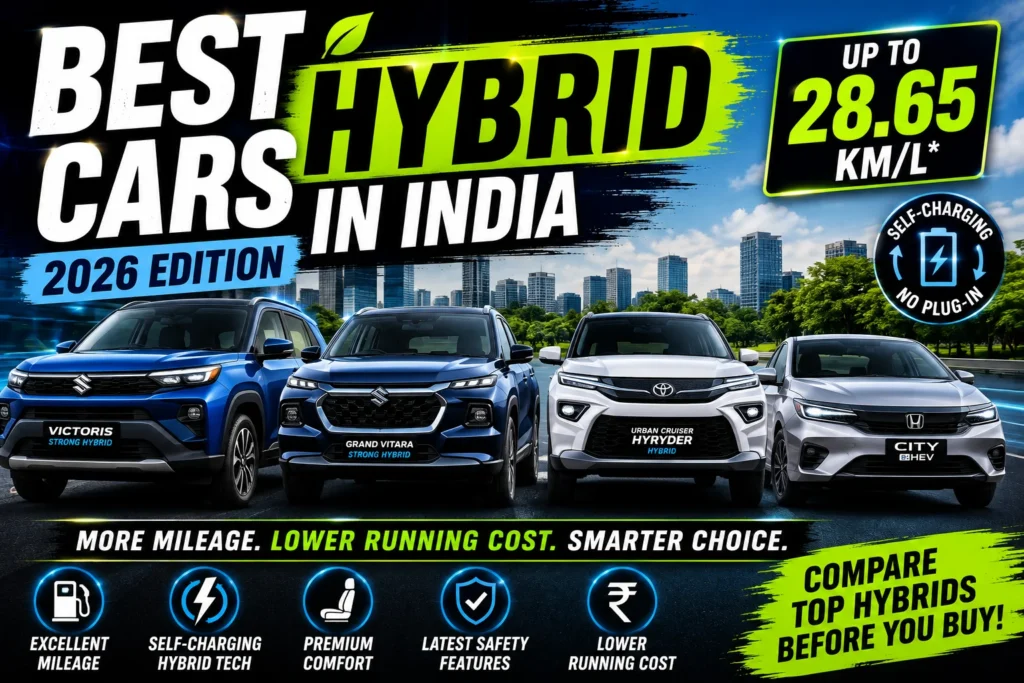
Best Hybrid Cars in India: Quick Comparison
| Car | Type | Claimed Mileage | Approx. Ex-Showroom Price |
|---|---|---|---|
| Maruti Suzuki Victoris Strong Hybrid | Strong Hybrid | 28.65 km/l | ₹16.43–19.99 lakh |
| Maruti Suzuki Grand Vitara Strong Hybrid | Strong Hybrid | 27.97 km/l | Around ₹16.99 lakh+ |
| Toyota Urban Cruiser Hyryder Hybrid | Strong Hybrid | 27.97 km/l | Around ₹15 lakh+ for Hybrid variants |
| Honda City e:HEV | Strong Hybrid | 27.26 km/l | ₹20.99 lakh |
| Toyota Innova HyCross Hybrid | Strong Hybrid | 22.16 km/l | Around ₹26 lakh+ |
| Maruti Suzuki Invicto | Strong Hybrid | 23.24 km/l | Around ₹25 lakh+ |
| Honda ZR-V e:HEV | Strong Hybrid | 22.79 km/l | ₹47.99 lakh |
| Kia Sorento Hybrid | Strong Hybrid | — | ₹27.99 lakh+ |
| Toyota Camry | Strong Hybrid | — | ₹48.69 lakh |
| Toyota Vellfire | Strong Hybrid | Around 19 km/l | ₹1 crore+ |
*Prices and availability can vary by city, variant and manufacturer updates. Mileage figures are manufacturer-certified figures where available and should not be treated as guaranteed real-world mileage.
What Is a Hybrid Car?
A hybrid car combines a petrol engine, electric motor and battery pack.
Depending on the system, the car can use:
- The petrol engine
- The electric motor
- Both together
Most strong hybrids sold in India use regenerative braking to recover energy during deceleration. That electricity is then stored in the battery and used to assist the vehicle later.
There are broadly three types of hybrid systems.
1. Mild Hybrid
A small electric motor assists the petrol engine but generally cannot power the vehicle independently for meaningful distances.
The main benefit is smoother operation and improved efficiency compared with a conventional petrol setup.
2. Strong Hybrid
A strong hybrid has a larger battery and electric motor. It can drive using electric power for short periods and can switch between petrol, electric and combined operation.
This is the technology behind cars such as the Grand Vitara, Hyryder, Victoris, City e:HEV and Innova HyCross Hybrid.
3. Plug-in Hybrid
A plug-in hybrid has a larger battery that can be charged externally and can normally travel considerably farther on electric power.
Plug-in hybrids remain relatively uncommon in India’s mainstream passenger-car market.
1. Maruti Suzuki Victoris Strong Hybrid
The Maruti Suzuki Victoris is one of the newest additions to India’s strong-hybrid SUV market.
Its strong-hybrid version uses a 1.5-litre petrol-electric powertrain with an e-CVT and has a certified fuel-efficiency figure of 28.65 km/l. Maruti lists the strong-hybrid range from approximately ₹16.43 lakh, with higher variants reaching around ₹20 lakh ex-showroom.
Key specifications
- Engine: 1.5-litre
- Hybrid system: Strong Hybrid
- Transmission: e-CVT
- Claimed mileage: 28.65 km/l
- Fuel tank: 45 litres
- Seating: 5
- Drive: 2WD
The Victoris is particularly interesting because it combines strong-hybrid efficiency with SUV styling and a long list of modern equipment.
Higher variants can include features such as a panoramic sunroof, digital instrument cluster, connected technology and advanced driver-assistance features.
Who should consider it?
The Victoris makes sense for buyers looking for a modern 5-seater SUV with excellent fuel-efficiency potential.
2. Maruti Suzuki Grand Vitara Strong Hybrid
The Grand Vitara Strong Hybrid helped make strong-hybrid technology more accessible in India’s mainstream SUV market.
It uses a 1.5-litre petrol-hybrid powertrain and an e-CVT transmission. Maruti lists its certified efficiency at 27.97 km/l.
Key specifications
- Engine: 1.5-litre
- System: Strong Hybrid
- Transmission: e-CVT
- Claimed mileage: 27.97 km/l
- Fuel tank: 45 litres
- Seating: 5
Maruti has expanded the Grand Vitara’s strong-hybrid lineup with additional variants, including the Delta+ Strong Hybrid.
One advantage of the Grand Vitara is that buyers can choose between different powertrain configurations, including petrol, CNG and strong hybrid, depending on their requirements.
Real-world mileage
Official mileage and actual fuel economy are not always the same.
In Autocar India’s testing, the Grand Vitara Strong Hybrid returned:
- City: 23.77 km/l
- Highway: 20.39 km/l
- Average: 22.08 km/l
This demonstrates why buyers should use certified mileage figures primarily for comparison and not as a guarantee of everyday fuel economy.
3. Toyota Urban Cruiser Hyryder Hybrid
The Toyota Urban Cruiser Hyryder shares its strong-hybrid technology with the Grand Vitara but has Toyota-specific styling, branding and dealer support.
Toyota lists the strong-hybrid version with a 1.5-litre TNGA petrol engine, electric motor and lithium-ion battery. Its certified fuel efficiency is 27.97 km/l.
Key specifications
- Engine: 1.5-litre
- Hybrid: Strong Hybrid
- Transmission: e-Drive
- Claimed mileage: 27.97 km/l
- Battery: Lithium-ion
- Fuel tank: 45 litres
- Seating: 5
The Hyryder also offers petrol and CNG powertrain options, giving buyers more choices.
Why consider the Hyryder?
The biggest attraction is its combination of:
- Strong-hybrid technology
- SUV body style
- High claimed mileage
- Toyota ownership ecosystem
- EV driving capability
- Automatic transmission
Toyota describes the Hyryder as a self-charging hybrid, meaning you don’t need to plug it into an external charger.
4. Honda City e:HEV
The Honda City e:HEV is one of the few hybrid sedans in India’s mainstream market.
Honda’s latest City e:HEV uses a 1.5-litre Atkinson-cycle petrol engine with a two-motor hybrid system and e-CVT.
Honda currently lists fuel efficiency of 27.26 km/l for the e:HEV. The combined system produces 126 PS and 253 Nm.
Key specifications
- Engine: 1.5-litre
- Hybrid: Two-motor strong hybrid
- Transmission: e-CVT
- Claimed mileage: 27.26 km/l
- Combined power: 126 PS
- Combined torque: 253 Nm
- Fuel tank: 40 litres
The City e:HEV also gets Honda SENSING safety technology, including features such as adaptive cruise control and lane-keeping assistance.
Price
The latest Honda City e:HEV is listed at approximately ₹20.99 lakh ex-showroom Delhi.
Best suited for
The City e:HEV is particularly relevant for buyers who prefer:
- A sedan
- Excellent fuel efficiency
- Premium cabin experience
- Strong city efficiency
- Long-distance comfort
5. Toyota Innova HyCross Hybrid
If you need a family MPV, the Toyota Innova HyCross Hybrid is one of the most significant hybrid options in India.
The Innova HyCross uses Toyota’s fifth-generation self-charging strong-hybrid technology.
Toyota currently advertises fuel efficiency of up to 22.16 km/l and an 8-year hybrid battery warranty.
Key specifications
- Engine: 2.0-litre
- Hybrid: Strong Hybrid
- Transmission: e-CVT
- Mileage: Up to 22.16 km/l
- Seating: 7/8 depending on variant
- Drive: Front-wheel drive
The biggest advantage is that you don’t have to choose between hybrid efficiency and family practicality.
You get:
- Three-row seating
- Large cabin
- Hybrid efficiency
- Automatic transmission
- Strong performance
- Long-distance comfort
Toyota announced in 2026 that cumulative Innova HyCross sales in India had crossed 2 lakh units since its launch in 2022.
Best suited for
Large families and buyers who regularly travel long distances with multiple passengers.
6. Maruti Suzuki Invicto
The Maruti Suzuki Invicto is a premium three-row MPV sold through Maruti’s NEXA network.
It uses a 2.0-litre strong-hybrid powertrain with an e-CVT.
Maruti lists its certified fuel efficiency at 23.24 km/l.
Key specifications
- Engine: 2.0-litre
- Hybrid: Strong Hybrid
- Transmission: e-CVT
- Mileage: 23.24 km/l
- Seating: 7/8
- Fuel tank: Around 52 litres
The Invicto shares its basic hybrid powertrain architecture with the Innova HyCross but is positioned through Maruti’s premium NEXA channel.
Best suited for
Large families wanting a premium hybrid MPV and Maruti’s sales/service ecosystem.
7. Honda ZR-V e:HEV
The Honda ZR-V e:HEV is one of the newest premium hybrid SUVs to enter the Indian market.
Honda introduced the ZR-V in India in 2026 as a completely built unit imported from Japan.
It uses a 2.0-litre Atkinson-cycle petrol engine and dual-motor hybrid system.
Honda quotes:
- Power: 184 PS
- Torque: 315 Nm
- Mileage: 22.79 km/l
- Transmission: e-CVT
The SUV is available with EV, Hybrid and Engine drive modes and offers Normal, Sport and Eco modes.
Honda announced an introductory price of ₹47.99 lakh ex-showroom Delhi, with deliveries beginning in July 2026.
Who is it for?
The ZR-V targets buyers who want a premium imported hybrid SUV rather than a mainstream mass-market hybrid.
8. Kia Sorento Hybrid
The Kia Sorento represents another new entry into India’s hybrid SUV segment.
The Indian-market Sorento is offered with a 1.6-litre turbo GDi hybrid powertrain paired with a 6-speed automatic transmission. Kia also offers a diesel powertrain for the model.
Key specifications
- Engine: 1.6-litre turbo petrol hybrid
- Hybrid system: Strong Hybrid
- Transmission: 6-speed automatic
- Seating: 6/7 depending on variant
- AWD: Available on higher variants
Kia’s India lineup lists the Sorento starting at ₹27.99 lakh for the HTE trim, while higher variants extend beyond ₹38 lakh.
Higher variants add features such as:
- Panoramic curved displays
- Bose audio
- 360-degree camera
- ADAS
- Ventilated seats
- Panoramic sunroof
- AWD
- Kia AI Assistant
The Sorento is therefore positioned significantly above mainstream hybrid SUVs such as the Grand Vitara and Hyryder.
9. Toyota Camry Hybrid
The Toyota Camry is a premium hybrid sedan for buyers who want a larger, more luxurious car.
The current Camry uses a 2.5-litre petrol engine combined with Toyota’s hybrid system.
Toyota lists:
- Petrol engine output: 187 PS
- Hybrid system output: 230 PS
- Transmission: e-CVT
- Battery: Lithium-ion
- Fuel tank: 50 litres
The current ex-showroom starting price is ₹48.69 lakh.
Why buy a Camry Hybrid?
The Camry focuses on:
- Premium comfort
- Refinement
- Long-distance cruising
- Hybrid efficiency
- Rear-seat comfort
- Smooth automatic operation
It is aimed at a very different buyer compared with the Grand Vitara or Hyryder.
10. Toyota Vellfire
At the luxury end of India’s hybrid market is the Toyota Vellfire.
The Vellfire uses a hybrid powertrain and focuses primarily on luxury, comfort and premium passenger transportation rather than simply maximizing fuel economy.
It offers:
- Three-row seating
- Luxury captain seats
- Premium interiors
- Hybrid powertrain
- Advanced comfort equipment
The Vellfire is substantially more expensive than mainstream hybrid cars, making it a luxury MPV rather than a conventional fuel-saving purchase. Current market listings put its mileage around 19.3 km/l.
Strong Hybrid vs Petrol: What Is the Difference?
The biggest difference is how the electric motor is used.
A conventional petrol car gets all of its propulsion from the internal-combustion engine.
A strong hybrid can use the electric motor for propulsion, particularly during low-speed driving and certain operating conditions.
The petrol engine can then take over or work together with the electric motor when additional power is required.
This can be particularly useful in stop-and-go city traffic, where frequent braking allows the system to recover energy.
Why Are Hybrid Cars Good for City Driving?
Hybrids can be especially efficient in urban conditions.
Consider what happens during city driving:
- The car accelerates.
- The electric motor assists.
- The driver slows down.
- Regenerative braking recovers some energy.
- The battery stores that energy.
- The electric motor can use it again.
A conventional petrol car loses much of the vehicle’s kinetic energy as heat during braking.
A hybrid system can recover part of that energy.
This is one reason strong hybrids can achieve impressive city mileage.
Hybrid vs Petrol vs Diesel vs EV
| Factor | Petrol | Diesel | Strong Hybrid | EV |
|---|---|---|---|---|
| Fuel type | Petrol | Diesel | Petrol + electricity | Electricity |
| External charging | No | No | No | Yes |
| City efficiency | Moderate | Good | Very good | Excellent |
| Highway range | Good | Excellent | Excellent | Depends on charging |
| Long-distance refuelling | Easy | Easy | Easy | Charging infrastructure needed |
| Tailpipe emissions | Higher | Higher | Lower | Zero tailpipe |
| Driving feel | Conventional | Strong torque | Smooth | Very smooth |
| Best use | General use | High-distance use | City + highway | Regular charging access |
Are Hybrid Cars More Expensive?
Generally, the strong-hybrid version of a vehicle costs more than an equivalent petrol version.
The reason is the additional technology:
- Electric motor
- Battery pack
- Power-control electronics
- Hybrid transmission
- Regenerative braking system
The important question is therefore not simply:
“Does a hybrid give better mileage?”
It usually does.
The more important question is:
“Will the additional purchase cost be recovered through fuel savings during my ownership?”
How to Calculate Hybrid Savings
Suppose a petrol SUV gives you approximately 15 km/l, while the hybrid version averages 22 km/l in your usage.
If you drive:
15,000 km/year
Petrol SUV consumption:
15,000 ÷ 15 = 1,000 litres
Hybrid consumption:
15,000 ÷ 22 = 682 litres
Potential saving:
318 litres/year
At an example petrol price of ₹100/litre:
₹31,800/year
Over five years:
₹1.59 lakh
This is only an illustration. Actual savings depend on your mileage, petrol price, traffic conditions, driving style and vehicle price difference.
What Are the Advantages of Hybrid Cars?
1. Excellent fuel efficiency
Strong hybrids can deliver significantly better fuel economy than many equivalent petrol vehicles.
2. No charging requirement
Unlike an EV, a conventional strong hybrid doesn’t require you to install a home charger.
3. Excellent city efficiency
Electric assistance and regenerative braking can be particularly useful in stop-start traffic.
4. Smooth driving experience
Electric motors provide instant torque and can make low-speed driving very smooth.
5. Long-distance convenience
You can simply refuel at a petrol station instead of planning charging stops.
6. Lower fuel consumption
For high-mileage users, the fuel savings can become meaningful over several years.
What Are the Disadvantages of Hybrid Cars?
1. Higher purchase price
The hybrid variant can cost considerably more than the equivalent petrol version.
2. More complex technology
A hybrid contains both an internal-combustion engine and an electric propulsion system.
3. Battery replacement concerns
Hybrid batteries are designed for long service life, but eventual replacement can be expensive depending on the vehicle and battery.
4. Limited choice
India has fewer hybrid models than petrol and diesel models.
5. Highway mileage advantage can shrink
Hybrids can be particularly effective in urban traffic. At sustained highway speeds, the efficiency advantage may be smaller depending on the vehicle and driving conditions.
Do Hybrid Batteries Need to Be Charged?
For most strong hybrids sold in India, no external charging is required.
The battery is charged through:
- Regenerative braking
- Engine-generated electricity
- The hybrid system’s energy management
Toyota calls the Hyryder a self-charging hybrid, while Maruti describes its strong-hybrid systems as incorporating EV mode and regenerative braking.
This is one of the biggest differences between a conventional strong hybrid and a plug-in hybrid.
How Long Do Hybrid Batteries Last?
Hybrid batteries are designed to operate for many years, but their actual lifespan depends on:
- Climate
- Usage
- Charging/discharging cycles
- Battery chemistry
- Vehicle design
- Maintenance
Manufacturers also provide battery warranties.
For example, Toyota currently advertises an 8-year hybrid battery warranty for the Innova HyCross. Honda’s latest City e:HEV comes with an 8-year/160,000-km battery warranty, whichever comes first.
Always check the exact warranty terms before buying.
Which Hybrid Is Suitable for Different Buyers?
For maximum fuel efficiency
Look at:
- Maruti Suzuki Victoris Strong Hybrid
- Grand Vitara Strong Hybrid
- Toyota Urban Cruiser Hyryder
- Honda City e:HEV
These models have certified mileage figures around or above 27 km/l.
For a family of 5
Consider:
- Victoris
- Grand Vitara
- Hyryder
- City e:HEV
For a large family
Consider:
- Toyota Innova HyCross
- Maruti Invicto
- Toyota Vellfire
- Kia Sorento
For a premium sedan
Consider:
- Toyota Camry
- Honda City e:HEV
For a premium hybrid SUV
Consider:
- Honda ZR-V
- Kia Sorento
Are Hybrid Cars Better Than EVs?
A hybrid isn’t automatically better or worse than an EV. The two technologies suit different usage patterns.
An EV can be particularly attractive if you have:
- Home charging
- Predictable daily travel
- Mostly city usage
- Access to reliable charging infrastructure
A hybrid can be more convenient if you:
- Frequently travel between cities
- Drive long highway distances
- Don’t have home charging
- Want high fuel efficiency without changing refuelling habits
For many buyers, the decision comes down to charging access and driving pattern, rather than simply fuel economy.
What Should You Check Before Buying a Hybrid?
Before purchasing, check these factors carefully.
1. Price difference
Compare the hybrid variant with the equivalent petrol version.
2. Your annual kilometres
A person driving 5,000 km per year may recover the hybrid premium more slowly than someone driving 20,000 km.
3. City vs highway usage
Strong hybrids can make particularly good sense for frequent urban driving.
4. Battery warranty
Read the exact warranty period and kilometre limit.
5. Service network
Make sure authorized service support is convenient in your city.
6. Boot space
Some hybrid systems can affect packaging, so compare luggage capacity between variants.
7. Test-drive experience
Hybrid powertrains can feel different from conventional petrol or diesel vehicles, particularly during acceleration and engine transitions.
Best Hybrid Cars in India 2026: Conclusion
India’s hybrid-car market has expanded significantly, moving beyond a small selection of premium models.
For mainstream SUV buyers, the Maruti Suzuki Victoris Strong Hybrid, Grand Vitara Strong Hybrid and Toyota Urban Cruiser Hyryder offer strong fuel-efficiency figures and SUV practicality.
The Honda City e:HEV remains an option for buyers who prefer a sedan, while the Toyota Innova HyCross and Maruti Invicto bring strong-hybrid technology to larger family MPVs.
At the premium end, models such as the Honda ZR-V, Kia Sorento, Toyota Camry and Toyota Vellfire demonstrate how hybrid technology is also being used in larger and more luxurious vehicles.
The key advantage of a strong hybrid is that it offers a middle ground between a conventional petrol car and an EV: high fuel efficiency without requiring external charging.
For buyers who drive extensively in cities but still want the convenience of petrol-powered long-distance travel, a strong hybrid can be an interesting alternative to both conventional petrol cars and EVs.
Frequently Asked Questions
Which hybrid car has the highest mileage in India?
Among the mainstream strong hybrids discussed here, the Maruti Suzuki Victoris Strong Hybrid has a certified fuel-efficiency figure of 28.65 km/l, while the Grand Vitara and Toyota Hyryder are listed at 27.97 km/l.
Which is the cheapest strong hybrid car in India?
The Maruti Suzuki Grand Vitara and Toyota Urban Cruiser Hyryder are among India’s more accessible strong-hybrid vehicles, although their hybrid variants cost considerably more than their entry-level petrol versions. The Victoris has also expanded the mainstream strong-hybrid choice.
Do hybrid cars need charging?
Most strong hybrids sold in India do not require external charging. Their batteries are replenished through regenerative braking and the vehicle’s hybrid system.
Are hybrid cars good for highway driving?
Yes. Hybrid cars can be used for long highway journeys without charging stops. However, their biggest fuel-efficiency advantage can often be seen in urban and stop-start driving.
Is a hybrid better than a petrol car?
The answer depends on usage. A hybrid generally offers better fuel efficiency, while a conventional petrol car can have a lower purchase price and simpler powertrain.
Is a hybrid better than an EV?
The two technologies have different advantages. An EV can eliminate petrol use but requires charging. A strong hybrid can deliver high efficiency while retaining conventional refuelling convenience.
Are hybrid batteries expensive to replace?
Potential replacement costs can be significant, but modern hybrid systems are designed for long service life and manufacturers provide battery warranties. Check the specific manufacturer’s warranty before purchasing.
Sources
- Maruti Suzuki – Strong Hybrid Technology
- Maruti Suzuki – Victoris specifications and pricing
- Toyota – Urban Cruiser Hyryder
- Toyota – Innova H