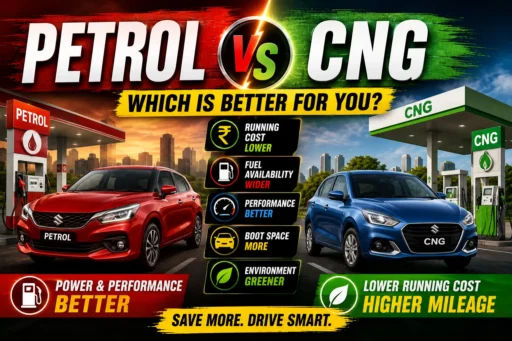

Choosing between a petrol car and a CNG car is an important decision for Indian car buyers. While petrol cars offer easier refuelling, stronger performance in many models and a wider choice of variants, CNG cars can significantly reduce the cost of daily commuting.
CNG has become particularly popular among buyers who drive long distances every month. Factory-fitted CNG cars are now available across hatchbacks, sedans, SUVs and MPVs, with manufacturers such as Maruti Suzuki offering CNG versions of models including the Swift, Dzire, Baleno, Brezza, Ertiga, XL6 and Victoris.
But does CNG always make more sense?
Not necessarily.
The right choice depends on your annual running, access to CNG stations, type of driving, required boot space, performance expectations and how long you plan to keep the car.
Let’s compare petrol vs CNG in detail.
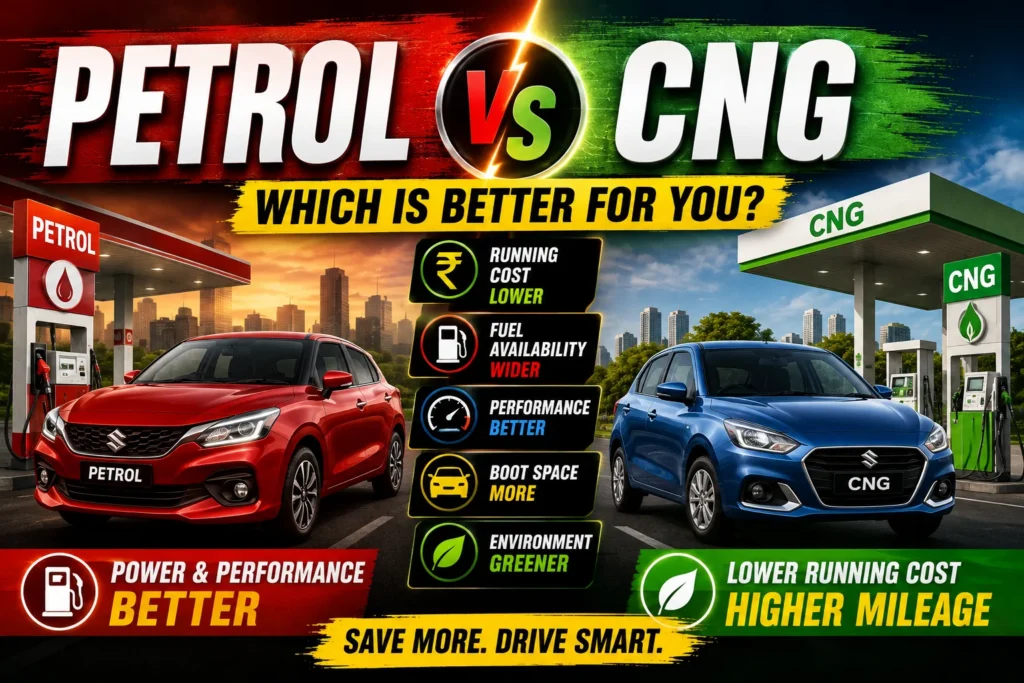
Petrol vs CNG: Quick Comparison
| Factor | Petrol | CNG |
|---|---|---|
| Fuel cost | Higher | Generally lower |
| Mileage | Good | Usually higher on a km-per-cost basis |
| Performance | Usually stronger | Usually slightly lower |
| Refuelling network | Very extensive | Growing but less extensive |
| Refuelling time | Short | Can involve queues at busy stations |
| Boot space | Usually better | Can be reduced, depending on tank design |
| Long-distance travel | Very convenient | Depends on CNG availability |
| Initial purchase price | Lower | Usually higher |
| Maintenance | Conventional | Additional CNG system components |
| Fuel availability | Excellent | City-dependent |
| Best for | Mixed usage | High daily running |
| Environmental impact | Higher emissions than CNG | Generally lower tailpipe pollutants |
IndianOil describes CNG as an economical alternative to petrol and notes that CNG vehicles generally have lower operating costs.
What Is a Petrol Car?
A petrol car uses a conventional internal-combustion engine where petrol is mixed with air and combusted inside the engine to generate power.
Petrol remains one of India’s most widely available automotive fuels.
The biggest advantages of petrol cars are:
- Extensive fuel-station availability
- Easy and quick refuelling
- Smooth engine operation
- Strong performance
- Large choice of cars and variants
- No CNG-cylinder packaging requirement
- Better suitability for drivers who frequently travel where CNG isn’t available
For buyers who drive relatively few kilometres every month, petrol can also make more financial sense because the initial purchase price is usually lower than the equivalent factory-fitted CNG variant.
What Is a CNG Car?
CNG stands for Compressed Natural Gas.
It is stored inside the vehicle at high pressure and supplied to a specially calibrated engine.
Factory-fitted CNG cars are generally bi-fuel vehicles, meaning they can operate using both CNG and petrol.
This gives the driver a backup fuel.
IndianOil notes that CNG cylinders for four-wheelers generally hold around 9–10 kg of CNG, with a typical range of approximately 180–230 km per fill, although actual range varies by vehicle and conditions.
Modern factory-fitted CNG vehicles also use dedicated components and calibration designed specifically for CNG operation.
For example, Maruti Suzuki’s S-CNG technology uses stainless-steel pipes and joints, integrated wiring and dedicated fuel-system components.
Petrol vs CNG Mileage
Mileage is one of the biggest reasons buyers consider CNG.
However, CNG mileage is usually expressed in km/kg, while petrol mileage is expressed in km/litre.
Therefore, you should not directly compare:
30 km/kg CNG
with
25 km/l petrol
and conclude that CNG is automatically 20% more efficient.
The two fuels have different energy densities and different retail pricing.
The more useful comparison is:
Cost per kilometre
This tells you how much you actually spend to travel one kilometre.
Petrol vs CNG Running Cost Example
Let’s use an illustrative example.
Assume:
Petrol price: ₹100/litre
CNG price: ₹80/kg
Suppose a car delivers:
Petrol: 20 km/l
CNG: 28 km/kg
Petrol cost per kilometre
₹100 ÷ 20 = ₹5/km
CNG cost per kilometre
₹80 ÷ 28 = ₹2.86/km
That means the CNG version would cost approximately:
₹2.14 less per kilometre
for this example.
If you drive:
15,000 km per year
Potential annual fuel-cost difference:
15,000 × ₹2.14
= ₹32,100 per year
This is only an illustration. Actual savings depend on your local petrol/CNG prices, real-world mileage and driving conditions.
CNG prices vary significantly across cities and geographic areas, while petrol prices also vary by location. IndianOil’s official CNG information shows different retail prices across its operating areas, and its petrol-price page notes that local prices can vary by outlet and location.
Example: Maruti Suzuki Dzire Petrol vs CNG
The current Maruti Suzuki Dzire provides a useful real-world example.
Maruti lists the Dzire with:
Petrol MT
24.79 km/l
CNG MT
33.73 km/kg
The manufacturer describes the Dzire as India’s most fuel-efficient sedan based on these certified figures.
The CNG version produces less power and torque than the petrol version:
| Specification | Petrol | CNG |
|---|---|---|
| Engine | 1.2L | 1.2L |
| Power | 81.58 PS | 69.75 PS* |
| Torque | 111.7 Nm | 101.8 Nm |
| Certified efficiency | 24.79 km/l | 33.73 km/kg |
*Figures can vary slightly by source/variant.
The difference illustrates an important point:
CNG can deliver lower running costs, but the petrol version generally offers stronger performance.
Maruti’s latest Dzire also carries a 5-star Bharat NCAP/Global NCAP safety rating and offers six airbags as standard.
Petrol vs CNG Performance
This is one area where petrol generally has an advantage.
CNG engines typically produce less maximum power and torque than their petrol counterparts.
For example, Maruti lists the Dzire’s 1.2-litre engine at:
Petrol: 81.58 PS and 111.7 Nm
CNG: 69.75 PS and 101.8 Nm
You may notice the difference particularly when:
- Overtaking
- Climbing steep roads
- Driving with several passengers
- Driving at high speeds
- Carrying luggage
- Using the air conditioner heavily
For relaxed city driving, however, a modern CNG car can provide perfectly adequate performance.
Petrol vs CNG in City Driving
CNG can be particularly attractive for people who spend a lot of time driving in cities.
Consider someone travelling:
50 km per day
for:
26 days per month
That’s:
50 × 26 = 1,300 km/month
Or:
15,600 km/year
At this kind of annual running, the difference in fuel cost can become significant.
This is why CNG has traditionally been popular among:
- Taxi operators
- Fleet owners
- Daily commuters
- Sales professionals
- Ride-hailing drivers
- High-mileage families
For someone driving only 500–600 km a month, however, the additional upfront cost of a CNG vehicle may take much longer to recover.
Petrol vs CNG for Highway Driving
Petrol has a major advantage when travelling through areas where CNG availability is limited.
India’s petrol network is far more extensive than its CNG network.
You can generally find petrol stations on:
- National highways
- State highways
- Rural roads
- Small towns
- Remote areas
CNG availability has expanded significantly, but it remains more concentrated around cities and established gas distribution areas.
Therefore, if your lifestyle involves frequent:
Interstate road trips + remote destinations
petrol can be more convenient.
If most of your driving takes place within a city with extensive CNG infrastructure, this disadvantage becomes much less important.
CNG Refuelling: The Biggest Practical Issue
CNG is not necessarily inconvenient, but you need to consider your local infrastructure.
Before purchasing a CNG car, check:
- How many CNG stations are near your home?
- Is there a station near your workplace?
- Are CNG stations available on your regular routes?
- How long are queues during peak hours?
- Are stations open when you usually travel?
This is particularly important because a CNG car can be economical only if you can conveniently access CNG.
If you regularly have to drive several kilometres out of your way to find a CNG station, some of the fuel-cost advantage can be lost.
Petrol vs CNG Boot Space
This is another major difference.
Traditional CNG systems used large cylinders that occupied significant boot space.
This can make it difficult to carry:
- Large suitcases
- Strollers
- Travel bags
- Shopping luggage
- Camping equipment
However, manufacturers are working on packaging solutions.
For example, the latest Maruti Suzuki Brezza S-CNG uses an underbody CNG tank configuration specifically designed to preserve boot space. Maruti also uses underbody CNG packaging on the Victoris.
Therefore, don’t assume every CNG car has the same boot-space compromise.
Always check the actual layout of the specific model.
Petrol vs CNG Maintenance
CNG combustion is generally cleaner than petrol combustion.
IndianOil says CNG produces fewer by-products entering engine oil, which can contribute to lower oil contamination and potentially lower maintenance requirements.
However, a CNG vehicle has additional components that need inspection and maintenance, including:
- CNG cylinder
- High-pressure lines
- Regulators
- Injectors
- Valves
- Pressure-related components
Factory-fitted CNG systems are engineered and calibrated for the vehicle.
That is very different from installing an aftermarket kit without considering manufacturer support.
Should You Buy a Factory CNG Car or Convert a Petrol Car?
For a new-car buyer, a factory-fitted CNG vehicle is generally the straightforward option.
Factory CNG vehicles are developed with:
- Dedicated engine calibration
- CNG-specific components
- Integrated safety systems
- Manufacturer warranty
- Properly designed fuel systems
Maruti, for example, says its S-CNG vehicles use a specially designed chassis, suspension and braking system and are calibrated for CNG operation.
Aftermarket conversion can be an option in some situations, but it adds another layer of consideration around kit quality, installation, certification, warranty and maintenance.
Is CNG Safer Than Petrol?
Both petrol and CNG vehicles can be engineered to meet automotive safety requirements.
CNG cylinders are designed to withstand high pressure.
IndianOil states that automotive CNG cylinders are tested to 300 bar, compared with a normal working pressure of around 200 bar.
CNG is also lighter than air, meaning leaked gas tends to disperse upward rather than pool on the ground.
However, safety still depends on:
- Proper installation
- Genuine components
- Regular inspection
- Correct refuelling procedures
- Manufacturer specifications
- Crash protection
- Overall vehicle design
This is another reason factory-fitted CNG systems are preferable for most new-car buyers.
Petrol vs CNG Emissions
CNG is generally considered a cleaner-burning fossil fuel than petrol.
IndianOil states that CNG produces lower CO₂ emissions than petrol and diesel and significantly lower levels of some pollutants. It also states that CNG vehicles produce no PM10 from the fuel combustion process.
However, CNG is still a fossil fuel.
It is therefore not equivalent to driving a battery-electric vehicle with zero tailpipe emissions.
For buyers concerned about urban air quality, CNG can provide an emissions advantage over conventional petrol operation, while the exact environmental impact depends on the vehicle, fuel composition and full fuel lifecycle.
Petrol vs CNG in Winter
CNG vehicles can operate normally in cold conditions, but very low temperatures and fuel-system conditions can affect starting and switching behaviour.
Modern factory-fitted systems automatically manage fuel switching.
Many CNG cars start using petrol and then transition to CNG once operating conditions are suitable.
This means you don’t normally have to manually manage the transition.
Petrol vs CNG With Air Conditioning
Running the air conditioner increases fuel consumption in both petrol and CNG vehicles.
In very hot weather, fuel efficiency can therefore be lower than the manufacturer’s certified figure.
The effect can be noticeable in:
- Heavy traffic
- Stop-start driving
- Long idling periods
- Full-load conditions
Don’t compare a CNG car’s official mileage directly with a petrol car’s real-world mileage.
Use actual fuel costs per kilometre instead.
Petrol vs CNG Resale Value
CNG cars can have strong demand in markets where:
- CNG infrastructure is widespread
- Fuel prices are relatively high
- Commercial usage is significant
- Buyers prioritize running costs
However, resale value varies by model, city, age, condition, mileage and market demand.
Therefore, don’t purchase a CNG car solely because you expect it to have better resale value.
Petrol vs CNG: Which Is Better for Low-Mileage Users?
If you drive:
5,000–7,000 km/year
a petrol car may be more practical.
Why?
Because your annual fuel savings from CNG may not be large enough to quickly recover the additional purchase price of the CNG variant.
For example, if the CNG version costs ₹1 lakh more than the petrol version, a driver covering only a few thousand kilometres annually could take many years to recover that difference.
Petrol vs CNG: Which Is Better for High-Mileage Users?
CNG becomes more financially interesting as annual mileage increases.
If you drive:
15,000–20,000+ km/year
the lower cost per kilometre can potentially offset the higher purchase price much faster.
This is particularly relevant for:
- Daily office commuters
- Taxi/fleet users
- Sales professionals
- Intercity commuters
- Large families with high annual usage
Break-Even Calculation
Suppose:
CNG car costs: ₹1,00,000 more than petrol
And you save approximately:
₹2 per kilometre
through lower fuel costs.
Your break-even distance would be:
₹1,00,000 ÷ ₹2
= 50,000 km
If you drive:
15,000 km/year
the theoretical break-even point would be around:
3.3 years
Again, this is only an illustration.
Actual break-even depends on:
- Petrol price
- CNG price
- Real-world mileage
- Purchase-price difference
- Maintenance
- Financing costs
- Insurance
- Your annual kilometres
Best CNG Cars in India
India’s CNG market has expanded considerably.
Some notable factory-fitted CNG options include:
Maruti Suzuki Swift CNG
Maruti lists the Swift S-CNG at 32.85 km/kg.
Maruti Suzuki Dzire CNG
The Dzire CNG is listed at 33.73 km/kg with the manual transmission.
Maruti Suzuki Baleno CNG
The Baleno is available with Maruti’s S-CNG technology.
Maruti Suzuki Brezza CNG
The Brezza offers the practicality of an SUV with factory-fitted CNG, and the latest version uses underbody CNG packaging to preserve boot space.
Maruti Suzuki Ertiga CNG
The Ertiga CNG is particularly relevant for large families and fleet users.
Maruti Suzuki XL6 CNG
The XL6 combines three-row practicality with CNG efficiency.
Maruti Suzuki Victoris CNG
The Victoris now offers underbody S-CNG technology while retaining SUV practicality.
Petrol vs CNG: Pros and Cons
Petrol — Advantages
- Excellent availability
- Fast refuelling
- Better performance in many applications
- More vehicle choices
- Better long-distance convenience
- Generally lower initial purchase price
- Usually better boot packaging
Petrol — Disadvantages
- Higher running cost
- Higher fuel expenditure for high-mileage users
- Generally higher fuel-related emissions than CNG
CNG — Advantages
- Lower running cost
- High fuel efficiency
- Suitable for high annual mileage
- Factory-fitted options are widely available
- Can run on petrol when CNG isn’t available
- Generally lower tailpipe pollutants than petrol
CNG — Disadvantages
- Higher purchase price in many models
- Lower performance in some vehicles
- CNG infrastructure is not equally available everywhere
- Refuelling can involve queues
- Cylinder packaging can affect luggage space
- Additional CNG components require maintenance
Petrol vs CNG: Which Fuel Should You Choose?
Choose Petrol if:
- You drive less than around 8,000–10,000 km annually.
- You frequently travel to areas without CNG.
- You want stronger performance.
- You regularly take long road trips.
- You want maximum boot flexibility.
- You prefer a lower upfront purchase price.
Choose CNG if:
- You drive 12,000–15,000+ km annually.
- Most of your driving happens within a CNG-covered city.
- Running cost is a major priority.
- You commute long distances every day.
- You are comfortable with slightly lower performance.
- You plan to keep the car for several years.
Petrol vs CNG: Final Verdict
There isn’t one fuel that is ideal for every Indian car buyer.
Petrol remains the more flexible choice because of its widespread availability, quick refuelling and broad vehicle selection.
CNG becomes increasingly attractive as your annual running increases. Its lower cost per kilometre can produce substantial fuel savings over several years, especially for people who regularly drive in cities with good CNG infrastructure.
For example, a commuter covering 15,000–20,000 km every year may find the additional purchase cost of a factory-fitted CNG car easier to justify than someone who drives only a few thousand kilometres annually.
The most important calculation isn’t simply:
“Which car gives better mileage?”
Instead, calculate:
Purchase price + fuel cost + maintenance + insurance + expected ownership period.
That gives you a much clearer picture of the actual cost of owning the car.
Frequently Asked Questions
Is CNG cheaper than petrol?
In most Indian markets, CNG generally has a lower cost per kilometre than petrol because its retail price and vehicle efficiency can produce lower running costs. However, the exact difference varies by city and vehicle.
Does CNG reduce car performance?
Usually, yes. CNG versions of the same engine can produce less maximum power and torque than petrol versions. The difference may be most noticeable during hard acceleration, overtaking and full-load driving.
Is CNG good for long-distance driving?
Yes, provided CNG stations are available along your route. Since CNG cars also carry petrol, you have a backup fuel, but relying only on CNG can be inconvenient on routes with limited infrastructure.
Does CNG damage the engine?
A properly engineered, factory-fitted CNG system is designed for CNG operation. Regular servicing and following the manufacturer’s maintenance schedule are important.
Which is better for daily office commuting: petrol or CNG?
For a high-mileage daily commute in an area with good CNG availability, CNG can significantly reduce running costs. For a short commute, petrol may be more practical because the fuel-cost savings are smaller.
Is CNG better than petrol for the environment?
CNG generally produces lower levels of several tailpipe pollutants and lower CO₂ emissions than petrol, according to IndianOil. However, CNG remains a fossil fuel and isn’t equivalent to a zero-tailpipe-emission EV.
Does CNG reduce boot space?
It can, depending on how the manufacturer packages the cylinder. Some newer vehicles use underbody CNG tanks to preserve luggage space, such as the latest Brezza and Victoris.
Can a CNG car run on petrol?
Yes. Factory-fitted CNG passenger cars in India are generally bi-fuel vehicles that can switch between CNG and petrol.
Is a factory CNG car better than an aftermarket CNG kit?
For a new-car buyer, a factory-fitted system provides vehicle-specific engineering, calibration, safety integration and manufacturer warranty support. Aftermarket conversions require additional consideration of kit quality, installation, certification and warranty.
Sources
- IndianOil – Compressed Natural Gas
- IndianOil – Petrol & Diesel Prices
- Maruti Suzuki – S-CNG Technology
- Maruti Suzuki – Dzire
- Maruti Suzuki – Swift
- Maruti Suzuki – Victoris
- Ministry of Road Transport & Highways – CMVR Emission Standards
Hashtags
#PetrolVsCNG #PetrolVsCNG2026 #CNGCarsIndia #PetrolCars #CNGCars #BestCNGCars #BestCarsIndia #CNGVsPetrol #CarBuyingGuide #CarMileage #CarRunningCost #FuelEfficientCars #CNGCar #PetrolCar #MarutiSuzuki #Dzire #Swift #Brezza #Ertiga #Victoris #AutoSidana